


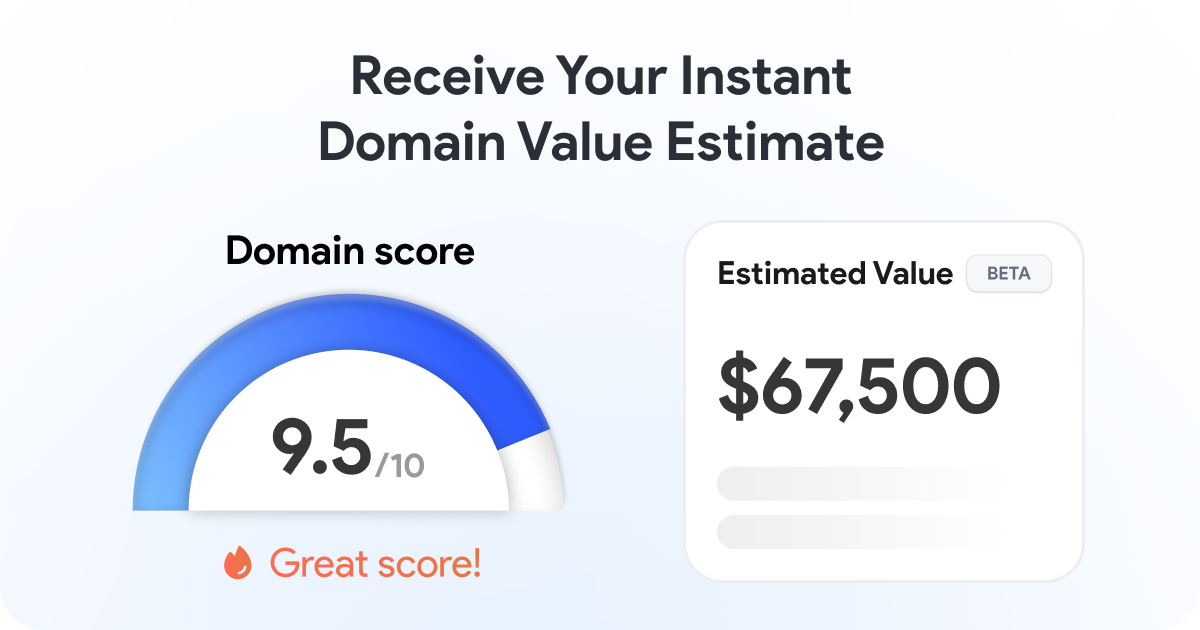
Knowing what a domain name may be worth is useful whether you are buying a domain, selling one, evaluating a digital asset or deciding whether a renewal is still justified.
The difficulty is that a domain does not have one fixed market price. Its potential value depends on factors such as extension, length, commercial relevance, brandability, comparable sales and the type of buyer interested in it.
A modern domain valuation tool can bring several of these signals together and provide an estimated value or price range. The estimate should be treated as a starting point rather than a guaranteed selling price.
This guide explains how a domain value analysis tool works, which factors matter most and how to interpret automated valuations without relying on a single number.
What Is a Domain Value Analysis Tool?
A domain value analysis tool is software that evaluates characteristics of a domain name and uses available market signals to estimate its potential value.
Depending on the tool, the analysis may consider:
- Domain extension
- Domain length
- Keyword relevance
- Search demand
- Commercial intent
- Comparable domain sales
- Brandability
- Market trends
- Domain structure
Some tools may incorporate additional signals, but the underlying objective is similar: transform several pieces of information into a useful valuation estimate.
Why Domain Valuation Is Difficult
A domain is not a standardized asset. Two names with the same number of characters can have very different levels of buyer demand.
Consider the difference between a short domain containing a recognizable commercial term and a longer domain containing several unrelated words. Both are technically domain names, but their potential use and buyer pool may be very different.
Another challenge is that the final sale price depends on the buyer.
An investor looking for resale margin may value a domain differently from a company that considers the same domain an ideal name for its next product.
This is why automated valuation should usually be interpreted as market guidance rather than an exact prediction.
How a Domain Value Analysis Tool Works
A valuation tool typically begins by examining measurable characteristics of the domain.
The original TechInsiderz article identifies signals such as search demand, CPC benchmarks, competition, historical sales, extension performance and domain structure. :contentReference[oaicite:3]{index=3}
A simplified process looks like this:
- The domain is submitted for analysis.
- The tool identifies its extension and structure.
- Keywords or recognizable terms are evaluated.
- Available market or search signals are considered.
- Comparable historical sales may be identified.
- The signals are combined into an estimated value or range.
Different valuation systems can use different data and weighting methods, which is why two tools may return different estimates for the same domain.
7 Factors That Influence Domain Value
1. Domain Extension
The extension is one of the first characteristics buyers see.
Different extensions serve different markets and audiences. A familiar extension may have a broader pool of potential buyers, while a specialized extension can be valuable when it strongly matches a particular industry or use case.
Do not assume that the extension alone determines value. The name and extension need to work together.
2. Domain Length
Shorter domains can be easier to remember, type and communicate, but length should not be evaluated in isolation.
A clear two-word name may be more useful than a shorter combination of letters with no obvious meaning.
When evaluating length, consider:
- Ease of typing
- Ease of pronunciation
- Memorability
- Clarity
- Potential spelling confusion
3. Keyword Commercial Intent
A domain containing terms associated with products, services or valuable business categories may attract commercial interest.
For example, keywords connected with software, finance, security or other commercially active industries can be relevant to buyers operating in those markets.
Search volume alone, however, does not prove that a domain is valuable. Buyer intent and brand suitability matter too.
4. Brandability
Some domains derive much of their potential value from being suitable as a brand rather than from exact search demand.
A brandable domain is generally easier to:
- Remember
- Pronounce
- Spell
- Use in conversation
- Place on marketing material
Names that are confusing, awkward or easy to mistype may be less attractive even when they contain useful keywords.
5. Comparable Domain Sales
Comparable sales can provide useful context because they show what buyers have previously paid for domains with somewhat similar characteristics.
The original article correctly treats comparable sales as an important part of valuation. :contentReference[oaicite:4]{index=4}
However, finding a comparable sale does not mean your domain has exactly the same value.
Consider differences in:
- Extension
- Length
- Keyword quality
- Industry
- Sale date
- Buyer circumstances
- Overall brandability
6. Market Demand
Domain demand can change as industries, products and technologies evolve.
A term that attracts strong commercial interest today may have had little buyer demand several years ago.
This makes valuation partly time-sensitive. Historical sales remain useful, but recent market context also matters.
7. Buyer Use Case
One of the hardest factors for an automated tool to measure is strategic buyer value.
A domain may be worth substantially more to a business when it:
- Matches its brand
- Matches a new product
- Improves brand clarity
- Supports an international expansion
- Protects an existing brand
This is one reason the eventual negotiated price can differ from an automated estimate.
Domain Value Analysis Tool vs Manual Appraisal
| Factor | Automated Analysis | Manual Analysis |
|---|---|---|
| Speed | Usually fast | Requires more research |
| Consistency | Uses repeatable criteria | Depends on evaluator |
| Comparable data | May process automatically | Can be selected manually |
| Brand context | Can be difficult to measure | Can consider qualitative factors |
| Buyer-specific value | Limited | Can consider strategic fit |
| Best use | Initial estimate | Deeper evaluation |
For important domains, the two approaches can complement each other. Use automated analysis for an initial benchmark and manual research to understand the wider market context.
Why Comparable Domain Sales Matter
Comparable sales provide evidence that similar types of domains have attracted real buyers.
But the comparison needs to be meaningful.
For example, comparing a two-word technology domain with an unrelated one-word financial domain simply because both use the same extension may produce a misleading benchmark.
A better comparable analysis looks for similarities across several characteristics.
| Comparison Factor | Why It Matters |
|---|---|
| Extension | Different extensions can have different buyer markets |
| Length | Short and long names can attract different demand |
| Keyword | Commercial meaning affects buyer interest |
| Industry | Some sectors have stronger naming demand |
| Brandability | Memorable names can appeal beyond exact-match buyers |
| Sale timing | Market conditions change over time |
How AI Can Improve Domain Valuation Tools
Domain valuation is an interesting use case for AI because it combines structured data with qualitative characteristics.
Traditional software can process measurable signals such as:
- Length
- Extension
- Keyword metrics
- Historical sales
- Search-related data
AI models can potentially add another layer by helping analyze characteristics such as language patterns, semantic relevance and brand-like qualities.
That does not mean AI can know the exact future selling price. Buyer intent and negotiation remain difficult to predict.
This hybrid approach—using conventional software for deterministic data and AI for more contextual analysis—is similar to the architecture discussed in our guide to custom AI and traditional software.
Data Quality Matters More Than an Impressive Algorithm
A sophisticated valuation model can still produce weak estimates if the information feeding it is incomplete or irrelevant.
Useful inputs may include:
- Relevant comparable sales
- Recent market information
- Keyword information
- Extension-level data
- Commercial context
This principle applies across AI and analytics systems: outputs depend heavily on the quality and relevance of their inputs.
Our guide to SAS migration to cloud discusses the wider importance of data architecture and validation when modernizing analytics systems.
How APIs Can Power Domain Valuation Platforms
A domain valuation service may depend on several data sources rather than one internal database.
APIs can potentially connect the application with services that provide information related to:
- Domain registration
- Search metrics
- Historical sales
- Keyword information
- Marketplace data
When multiple services are connected, the application also needs to handle unavailable or incomplete data gracefully.
Developers should understand which data source produced each signal and avoid allowing one failed integration to make the entire valuation workflow unreliable.
Our guide to the top API security testing tools for 2026 explains how connected applications can test authentication, authorization and API exposure.
Building a Domain Valuation Application
A domain value analysis tool is also a useful example of a modern data-driven web application.
A simplified architecture might include:
- User submits a domain.
- The backend validates the input.
- External and internal data sources are queried.
- Relevant metrics are normalized.
- A valuation model processes the signals.
- The application generates an estimate.
- The interface explains the factors influencing the result.
The backend needs to manage API calls, data processing, caching, error handling and potentially user accounts or saved valuations.
Our guide to hiring Django developers explains the backend, database and API skills useful when developing data-driven web applications.
Why Explainable Valuations Are Better
A valuation result becomes more useful when the tool explains why it produced the estimate.
Instead of displaying only:
Estimated value: $X
a stronger interface could show the major signals behind the estimate:
- Extension strength
- Domain length
- Keyword characteristics
- Comparable sales
- Brandability assessment
- Current market context
This helps users decide whether the estimate makes sense for their specific domain.
It also reduces the risk of treating an automated number as unquestionable.
Common Domain Valuation Mistakes
Relying on One Metric
High search demand does not automatically create a valuable domain.
A domain may contain a popular keyword but still be difficult to brand, awkward to type or unsuitable for a commercial buyer.
Taking Automated Estimates Literally
A tool produces an estimate, not a guaranteed selling price.
The final market value is whatever a willing buyer and seller ultimately agree on.
Ignoring Comparable Quality
Finding a high-priced historical sale does not make it a useful comparable if the domains are fundamentally different.
Pricing Emotionally
The amount of time or money you personally invested in a domain does not necessarily influence what another buyer is willing to pay.
The original article makes the same useful distinction between personal attachment and buyer ROI. :contentReference[oaicite:5]{index=5}
Ignoring Market Timing
Buyer interest changes as industries and technologies evolve. A valuation should therefore consider current market conditions rather than relying only on old sales.
Assuming Every Short Domain Is Valuable
Length matters, but a short combination with no clear meaning or buyer use case may have limited demand.
How to Estimate Your Domain’s Value Step by Step
- Run an automated valuation: Use it as your initial benchmark rather than your final price.
- Review the extension: Consider how buyers in the target market view it.
- Evaluate the words: Determine whether they have commercial or branding relevance.
- Check comparable sales: Look for genuinely similar domains.
- Assess brandability: Consider spelling, pronunciation and memorability.
- Review market demand: Determine whether the underlying topic or industry attracts active businesses.
- Identify possible buyers: Think about who could realistically use the name.
- Create a price range: Use a range rather than assuming one exact number.
Domain Valuation Checklist
- Is the domain easy to spell?
- Is it easy to pronounce?
- Is it reasonably concise?
- Does the extension fit the likely use?
- Does the name have commercial relevance?
- Could it work as a recognizable brand?
- Are there relevant comparable sales?
- Is there current buyer demand in the niche?
- Does the name avoid unnecessary numbers or confusing characters?
- Can you identify realistic potential buyers?
- Does the automated estimate explain its reasoning?
Domain Value Analysis for Buyers
Valuation tools are not useful only for sellers.
A buyer can use an estimate to evaluate whether an asking price appears broadly consistent with available market signals.
Before purchasing, consider:
- Whether the domain solves a genuine branding problem
- Alternative names available
- Comparable historical sales
- The importance of the exact name to the business
- Long-term use rather than only resale potential
A strategic buyer may reasonably pay more than an investor when the domain has a specific business purpose.
Domain Value Analysis for Sellers
Sellers can use valuation tools to establish an initial pricing framework.
A practical strategy may involve three numbers:
- Target price: The amount you would ideally like to receive.
- Negotiation range: A realistic area where you would consider a deal.
- Minimum acceptable price: The point below which you prefer to keep the asset.
These values should reflect market evidence rather than simply multiplying the original registration cost.
Can a Domain Valuation Tool Predict the Final Sale Price?
No tool can reliably know what a specific buyer will ultimately pay.
Automated analysis is better suited to answering a different question:
Based on the information available, what range appears reasonable enough to investigate further?
That distinction is important.
Domain transactions involve negotiation, timing, buyer motivation and availability of alternatives—factors that can be difficult for an automated model to fully capture.
What to Look for in a Domain Value Analysis Tool
| Feature | Why It Matters |
|---|---|
| Comparable sales | Provides real-market context |
| Multiple valuation signals | Reduces dependence on one metric |
| Clear methodology | Helps users understand the estimate |
| Market context | Accounts for changing demand |
| Keyword analysis | Helps evaluate commercial relevance |
| Brandability analysis | Adds qualitative context |
| Price range | More realistic than false precision |
Frequently Asked Questions
What is a domain value analysis tool?
It is software that analyzes characteristics and market signals associated with a domain to produce an estimated value or valuation range.
Are automated domain valuations accurate?
They can provide useful benchmarks, but they should not be treated as guaranteed sale prices. Different tools may use different data and valuation models.
What increases the value of a domain?
Potential value can be influenced by extension, length, commercial relevance, brandability, comparable sales, market demand and buyer use case.
Why are comparable domain sales important?
They provide evidence of what buyers have previously paid for domains with similar characteristics, although no two domains are exactly alike.
Does high search volume make a domain valuable?
Not automatically. Search demand is only one signal. Commercial intent, branding potential, extension and buyer demand also matter.
Can AI determine the exact value of a domain?
No. AI can help analyze data and contextual characteristics, but the final sale price still depends on the buyer, seller, timing and negotiation.
Final Thoughts
A domain value analysis tool can make the appraisal process faster by combining several useful signals into an initial estimate.
The strongest valuation process does not stop there.
Review comparable sales, extension strength, commercial relevance, brandability, current market demand and realistic buyer use cases before deciding what a domain may be worth.
Most importantly, treat automated valuation as decision support rather than certainty. A useful tool should help you understand the evidence behind the estimate, not simply display an impressive number.
For more analysis of AI, software, cloud infrastructure and other technologies powering modern digital tools, see our technology trends and tech news insights for 2026.