


Introduction: Failure Is Common, But Not Random
Prop firm challenges are designed to look simple. Clear rules, defined profit targets, and access to large capital make them attractive. Yet the majority of traders fail their first attempt.
This failure is not usually caused by bad strategies or lack of market knowledge. In most cases, it comes down to behavior. Understanding why traders fail is the first step toward avoiding the same mistakes.
The Biggest Reason: Breaking Risk Rules
The most common cause of failure is violating drawdown rules.
Many traders:
- Increase lot size after early wins
- Try to recover losses too quickly
- Ignore daily loss limits during volatile sessions
Prop firms are not testing how much you can make in one trade. They are testing whether you can protect capital. Platforms like Funded Trader Markets are built around strict risk control, not aggressive profit chasing.
Overtrading Is More Dangerous Than Losing Trades
Another major issue is overtrading.
Traders often feel pressure to trade every day, even when:
- Market conditions are unclear
- Setups don’t align with their strategy
- Emotions are already elevated
Overtrading increases exposure without increasing edge. One or two unnecessary trades are often enough to fail an otherwise solid evaluation.
Emotional Trading Under Time Pressure
Time limits can quietly sabotage performance.
As the deadline approaches, traders may:
- Force low-quality setups
- Trade outside their plan
- Increase risk per trade
This mindset shifts focus from execution to urgency. Ironically, the pressure to pass faster often leads to failing sooner.
Strategy Switching Mid-Challenge
Many traders abandon their strategy after a small drawdown.
Instead of trusting their tested approach, they:
- Change indicators
- Enter unfamiliar setups
- Follow impulse trades
Consistency matters more than optimization. Prop firms reward stability, not constant adjustment.
Ignoring Evaluation Structure
Every challenge model has its own logic.
For example, phased models like two-step evaluation challenges are designed to measure consistency over time, not quick spikes in profit. Traders who treat both phases the same often struggle in verification.
Understanding what each phase tests helps you adjust expectations and pacing.
Lack of Journaling and Self-Review
Most failed traders cannot clearly explain why they lost.
Without journaling:
- Mistakes repeat
- Emotional triggers go unnoticed
- Risk habits don’t improve
Even a simple journal tracking entries, exits, and emotions can dramatically improve outcomes on future attempts.
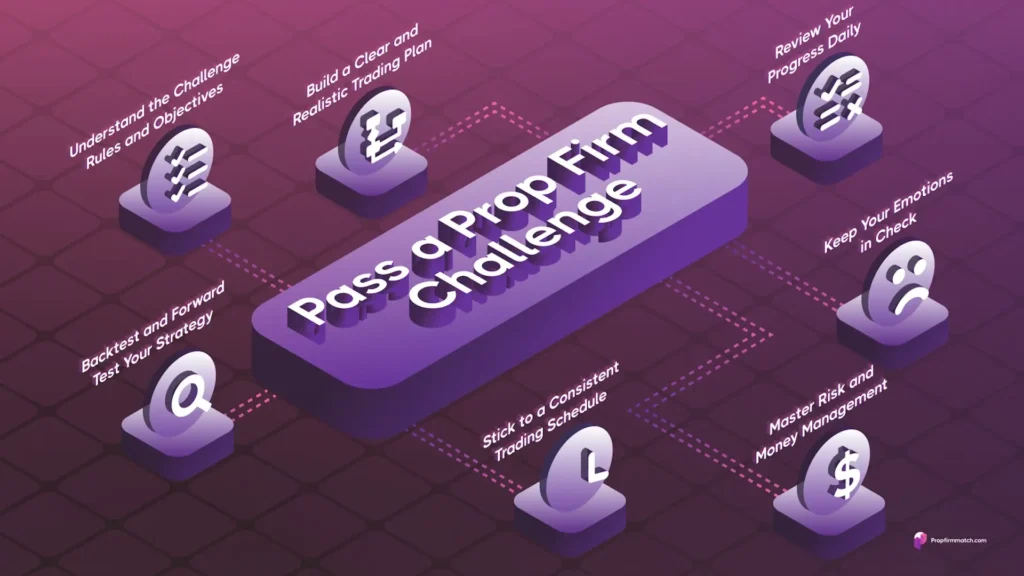
How Successful Traders Avoid These Pitfalls
Traders who pass consistently do a few things differently:
- Risk less than they’re allowed
- Trade fewer but higher-quality setups
- Stop trading after drawdown hits
- Treat rules as non-negotiable
They aim to survive first and profit second.
Conclusion: Passing Is About Control, Not Talent
Prop firm challenges don’t reward brilliance. They reward discipline.
Most failures happen because traders try to outsmart the system instead of working within it. When you respect the rules, manage emotions, and prioritize consistency, passing becomes far more achievable.
Avoid the common traps, trade like a professional, and the funded account will follow.