


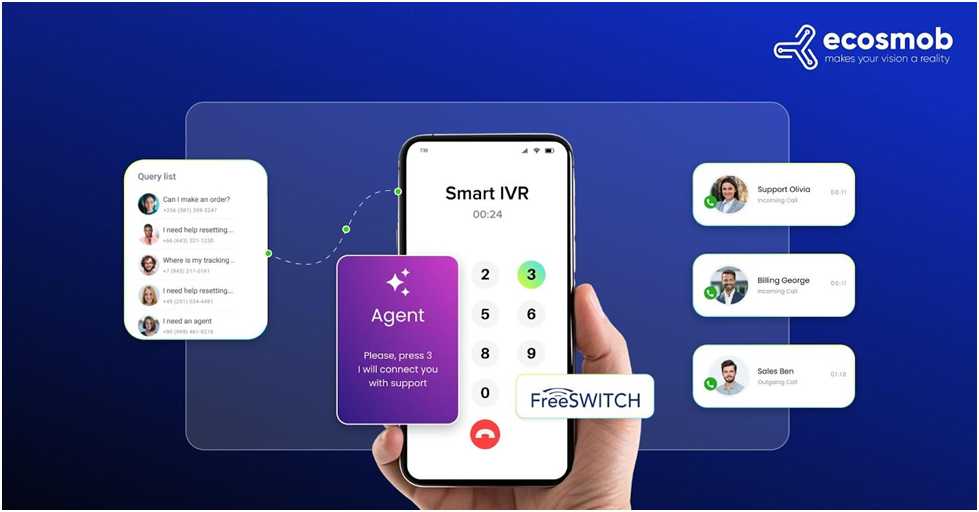
If you’ve ever found yourself screaming “Representative!” into a phone, you understand the core failure of modern customer service. The rigid, unforgiving DTMF menu system, the standard IVR, is a decades-old relic that has become a liability.
For VoIP AI integration solutions, it’s about eliminating the menus entirely.
By pairing the highly scalable, open-source reliability of FreeSWITCH with the sophisticated cognitive intelligence of OpenAI, you can build conversational IVR solutions that actually understand the user’s intent, context, and frustration level (and resolve the issue immediately).
This blog details the architectural journey: why legacy systems fail, how to engineer the continuous data pipeline required for real-time AI, and the critical steps UCaaS platforms must take to deploy these solutions securely and at scale.
Why Are Traditional IVRs Failing Your Customers?
The decision to adopt generative AI in the call center is driven by the failure of existing technology.
Traditional Dual-Tone Multi-Frequency (DTMF) IVRs are designed for navigation, forcing the caller to follow rigid menu trees.
- Rigid menu trees force false choices: Your customer wants to “change the billing date on my subscription.” Is that billing? Account management? Technical support? They guess wrong, get transferred, explain their issue again, get transferred again,
- Voice recognition without comprehension is theater: Some modern IVRs accept voice input but only match against a predefined list of keywords.
- Context evaporates at every transfer: Traditional IVRs collect information, then route the call, but that context rarely follows.
- No learning or improvement happens: Your IVR processes thousands of calls daily, but gains zero intelligence from those interactions.
Conversational IVR solutions eliminate these problems by understanding intent, maintaining context, and routing intelligently based on what callers actually need—not which menu option they selected.
How OpenAI Transforms IVRs and Boosts First Call Resolution
Integrating a robust Large Language Model (LLM) like OpenAI’s GPT transforms the IVR from a keyword matcher into a genuine conversational agent, solving the core deficits.
Natural Language Understanding (NLU)
Instead of parsing a single digit, the LLM processes the entire transcribed text for intent, context, and nuance. This allows the system to manage complex, multi-turn dialogue coherently.
Dynamic Response Generation
The LLM receives the transcribed text, coupled with the ongoing conversation history, and generates a dynamic, smart AI-generated response. OpenAI IVR development’s sophisticated reasoning is the key difference that drives higher First Call Resolution (FCR) rates by understanding and resolving the request on the first try.
Structured Output and Telephony Control
By training the LLM to output structured data (specific JSON commands), the generated response can be used to trigger precise telephony actions within the FreeSWITCH dialplan, acting as the system’s intelligent router.
How to Build an OpenAI-Powered Conversational IVR with FreeSWITCH?
Integrating OpenAI with FreeSWITCH to build conversational IVR solutions requires creating a continuous, low-latency pipeline connecting FreeSWITCH (the media controller) to the external AI services (the cognitive brain).
Step 1: Media Handling and Audio Capture (FreeSWITCH)
FreeSWITCH must capture raw audio frames from the live call leg. This captured audio stream is then efficiently forwarded to an external custom orchestrator application (often Python/Node.js) via a low-latency protocol like WebSockets.
The Critical Codec Challenge
The single most common failure point is a codec mismatch. Even if the incoming SIP call uses the 8kHz G.711 codec, the audio captured by the FreeSWITCH media bug is often internally converted to 16-bit PCM at 16kHz.
For successful transcription, developers must explicitly configure the external Automatic Speech Recognition (ASR) WebSocket connection to accept 16kHz audio, not the expected 8kHz µ-law.
Step 2: The Three-Component AI Pipeline
VoIP AI integration solutions must manage the synchronized chain of three external OpenAI components:
- Transcription (ASR): Converts the caller’s voice into highly accurate text.
- Intelligence (LLM/GPT): Processes the text for intent, retrieves necessary data, and formulates the dynamic response.
- Voice Output (TTS): Converts the LLM’s text response back into natural-sounding audio for instant playback.
Step 3: Achieving Real-Time Latency (The Golden Rule)
A system that cannot achieve human-like responsiveness will fail in production. Production voice AI agents must target 800ms or lower for total voice-to-voice latency (the time from the user finishing speaking until the AI’s synthesized response begins playback).
Streaming STT for Predictive Processing
Achieving sub-800ms latency requires abandoning traditional, buffered transcription. Streaming STT is non-negotiable for conversational AI. Instead of waiting for the full utterance, streaming STT produces “partial transcription hypotheses” every few hundred milliseconds.
This predictive processing allows the LLM to start retrieving context and initiating response generation before the user has finished speaking, potentially saving 200–400ms in every interaction.
How Should UCaaS Platforms Deploy Conversational IVRs at Scale?
UCaaS platforms can utilize the multi-tenant architecture and strong integration capabilities of platforms like FusionPBX.
FreeSWITCH, and by extension FusionPBX, is built for domain-based multi-tenant PBX and carrier-grade switching. This means UCaaS providers can:
- Isolation: Securely manage thousands of endpoints across different client environments from a single instance.
- Scalability: Utilize FreeSWITCH’s highly scalable, multi-threaded architecture to handle thousands of concurrent calls, making it the better choice over monolithic systems like Asterisk for large-scale deployments.
- Easy Management: Use the attractive FusionPBX GUI for user management while retaining the ability to perform advanced configuration directly via the FreeSWITCH Command Line Interface (fs_cli).
VoIP AI integration solutions deployment at scale also requires sustainable performance and cost management:
- Prompt Caching: Implementing advanced caching policies (like Tail-Optimized LRU) dramatically reduces cost and latency. OpenAI’s prompt caching achieves up to 50% cost reductions for cached tokens, while Anthropic’s implementation reports up to 90% savings depending on cache hit rate and usage patterns.
- Monitoring: Continuous monitoring of operational metrics (Resolution Rate, Abandonment Rate) and technical metrics (P95 Latency) is required to ensure the system remains compliant and cost-effective.
Ensuring Data Privacy with Cloud-Based AI Models
For secure OpenAI IVR development, security must be managed at the application and organizational level, particularly regarding API keys and conversational context.
Protecting OpenAI Credentials
API key management is a central security concern, as compromised keys lead to unexpected charges or data compromise. Providers must adhere to strict security protocols:
- Secure Routing: API keys must never be deployed in client-side environments (browsers or mobile apps). All requests must be securely proxied through your own backend orchestrator server, keeping the API key secure.
- Code Isolation: Credentials must be stored securely as environment variables (e.g., OPENAI_API_KEY) and never committed to source code repositories.
- Unique Keys: Utilize unique API keys for distinct team members and environments to allow for granular permission control.
Data Isolation in Multi-Tenant Environments
For UCaaS providers using shared resources, maintaining strict isolation between client data is mandatory:
- Tenant-Scoped Keys: When utilizing OpenAI features that store conversation context via response IDs, the application layer must ensure these response IDs are stored with tenant-scoped keys.
This prevents one tenant’s conversational history or data from contaminating or being accessed by another, which is crucial for compliance, monetization, and accurate per-tenant billing.
The gap between what callers expect and what traditional IVRs deliver has never been wider. People interact with ChatGPT, Google Assistant, and Siri daily; technologies that understand natural language and respond contextually. Then they call your business and get “press 1 for sales.”
Conversational IVR solutions built on FreeSWITCH and OpenAI eliminate that jarring disconnect.
Your IVR becomes an intelligent interface that understands intent, maintains context, routes appropriately, and actually helps callers reach resolution faster.
The technology exists. The integration patterns are proven.
The only question is whether you’ll deploy intelligent IVRs before your competitors do—or whether you’ll keep forcing customers to navigate phone trees designed for an era when “artificial intelligence” meant touch-tone detection.
Your callers are ready for IVRs that actually understand them. Is your infrastructure?
Let’s build conversational IVRs that make “press 1” obsolete!